


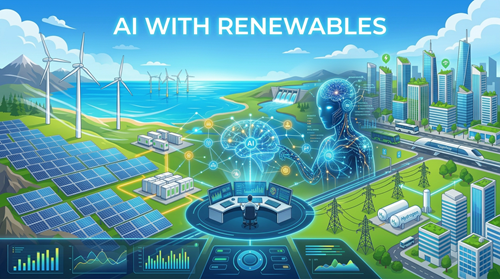
Artificial intelligence is still a stock market favourite – but the hopes pinned on it are now running into the trillions. However, data centres and the training of AI models require ever-increasing amounts of electricity. “Renewable energies therefore play a key role in the widespread adoption of this technology of the future”, comments Markus Voigt, Executive Chairman of the aream Group.
The global market for artificial intelligence (AI) is growing at an unprecedented rate: from US$190 billion in 2023, estimates suggest it will reach nearly US$5 trillion by 2033. Global spending on AI is expected to exceed US$2.5 trillion as early as 2026. At the same time, the energy requirements of digital infrastructure are rising dramatically. UN analyses show that data centres – the backbone of AI – will consume around 450 terawatt-hours of electricity as early as 2025. If AI were a country, it would rank 11th in the world in terms of energy consumption. By 2030, this demand could rise to as much as 1,000 TWh, and in subsequent years even to 1,300 TWh. This would mean that the electricity consumption of data centres would exceed that of entire economies.
Training modern AI models is particularly energy-intensive: GPT-4 alone is estimated to have required up to 70 GWh of electricity over 100 days – around 50 times more than GPT-3, according to the UN. Future systems would far exceed these figures and generate significant CO₂ emissions.
“Against this backdrop, the accelerated expansion of renewable energy is becoming a key prerequisite for sustainable AI growth”, said Voigt. Wind and solar energy are already the fastest-growing sources of electricity for data centres and are expected to cover almost 50 per cent of the additional demand by 2030. This trend is largely supported by long-term power purchase agreements (PPAs) between technology companies and energy producers. “To ensure competitiveness in the AI era whilst meeting climate targets”, says Voigt, “investment in renewable energy, grid infrastructure and storage technologies must be consistently expanded.”
The German solar plants in the aream portfolio suffered from curtailment last June; approximately 1,300 MWh will be compensated. In addition, a prolonged grid outage and inverter malfunctions caused by high temperatures together resulted in a loss of around 300 MWh. The target was therefore only 79 per cent achieved. However, when the volumes to be compensated for are taken into account, the target achievement rises to 97 per cent. The Spanish plants performed less well (67 per cent of the target achieved). Here too, curtailments of around 3,350 MWh played a major role, although 1,850 MWh will be reimbursed. The plants in Italy, by contrast, showed stable performance (99 per cent of the target achieved).
Wind conditions in June were in line with expectations. However, a better result for the aream plants was prevented by a curtailment (around 850 MWh), a fault in a pitch system lasting several days (approximately 125 MWh) and a ten-day plant shutdown due to grid works. The target was achieved to around 88 per cent.

PRESSEKONTAKT:
Leandra Kiebach
T: +49 (0)211 30 20 60 4-2
E: lk@aream.de