


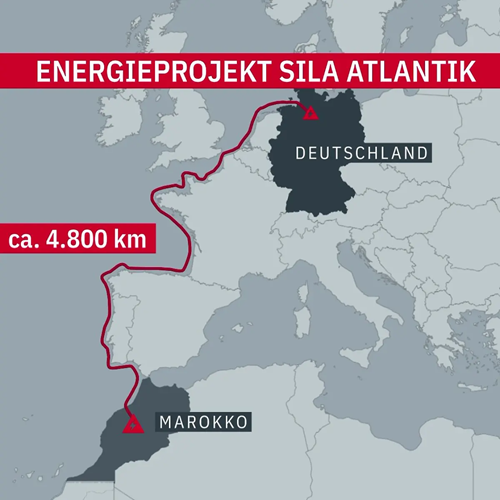
A new power station project in Morocco is attracting attention. Known as “Sila Atlantik”, the project involves the construction of a wind and solar park with a capacity of 15 gigawatts. The electricity is to be transmitted to Germany via a 4,800-kilometre-long subsea cable and is expected to cover up to five per cent of Germany’s current electricity consumption. “Politically, such a project may sound good”, says Patrick Lemcke-Braselmann, CEO of the aream Group. “But from both a technical and an economic perspective, it makes no sense.”
“Anyone wishing to invest these 30 to 40 billion euros must compare it with the alternative that lies right on our doorstep”, says Lemcke-Braselmann: for 30 billion euros, a hybrid portfolio comprising solar power, wind power and battery storage could be established in Germany. Here’s the maths: Twelve gigawatts of solar power costs around 5.8 billion euros, whilst eight gigawatts of wind power costs a further twelve billion euros or so. That leaves a further twelve billion euros or so for storage. Depending on the type of storage, this yields between 35 and 90 gigawatt-hours of capacity.
“The annual output of this portfolio is between 29 and 30 terawatt-hours”, says Lemcke-Braselmann. The Morocco project, by contrast, could supply 26 terawatt-hours at best. The German portfolio therefore comes out ahead – and that is even without taking into account the transmission losses associated with a 4,800-kilometre-long subsea cable. Over such a distance, these losses can easily reach double-digit percentages. “We would be laying a very long cable here, only to end up with less electricity than we would get from an expansion within our own country”, says Lemcke-Braselmann. “That makes no economic sense.”
The technical details also raise questions. The cable is designed to be able to transmit 1.8 gigawatts twice. This means that, out of 15 gigawatts of installed capacity in Morocco, only a portion will reach Europe at any one time. The remaining capacity would either go unused or have to be utilised locally. The project is reminiscent of Desertec, that vision from the 2000s which failed due to costs and geopolitical realities.
Furthermore, Germany has, in recent years, gone to considerable lengths to free itself from its dependence on Russian energy imports. A new dependency on non-European supply chains and vulnerable underwater infrastructure runs counter to this commitment. “First we go to great lengths to free ourselves from one dependency, only to then plan a new one”, says Lemcke-Braselmann.
The timetable also gives cause for scepticism. Even now, disputes over the institutional framework and state guarantees are delaying the project. Morocco is also calling for an intergovernmental agreement providing for electricity flows in both directions. Germany’s experience with major transmission projects offers further food for thought. SuedLink, a route some 700 kilometres long, has been in the planning stage for over a decade and is still not operational. A subsea cable six times that length, running through the territorial waters of five countries, is unlikely to be completed any faster.
Renewable energies have long been regarded as the cheapest form of electricity generation, including in Germany. Wind, solar power and storage facilities within the country’s own borders create local value and jobs. Transport distances remain short. No new geopolitical risks arise. The 30 billion euros earmarked for Sila Atlantik could be put to more effective use at home. “The energy transition and the increasing use of renewable energy in Germany do not require a mega-cable to the Sahara,” said Lemcke-Braselmann. “All that is needed is to speed up expansion at home.”

PRESSEKONTAKT:
Leandra Kiebach
T: +49 (0)211 30 20 60 4-2
E: lk@aream.de