


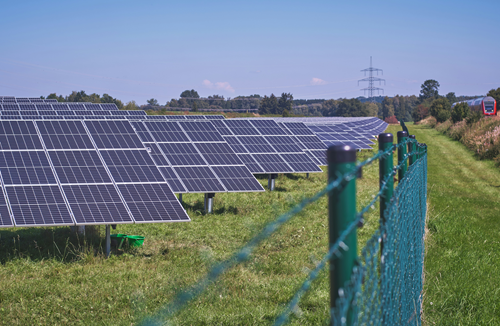
Times appear to be tough for the renewable energy sector. Not only has political support waned, but in recent months several established companies have also run into financial difficulties. “However, this is not a crisis of the technology itself, but rather a shake-out of certain financing and business models,” says Markus W. Voigt, Executive Chairman of the aream Group. “Investors who bought into the reality rather than the hype are in a strong position, and new opportunities are now opening up for them.”
There are three main reasons for the difficulties faced by individual companies. The first pattern concerns companies whose business model is based on the sale of developed projects. “Here, costs are incurred over a period of years for securing land, expert reports and planning permission, whilst revenue is only generated upon the sale of the completed project,” says Voigt. “Due to the turnaround in interest rates, achievable prices are falling, and buyers are taking longer to make decisions. Costs continue to accrue, whilst revenue is deferred into the future.” Some companies are also too broadly diversified; they rely on PV, wind, hydrogen, heating and storage, which entails very high upfront costs and, in some cases, overstretched organisations.
The second pattern concerns companies that hold portfolios of solar and wind farms on their own balance sheets and finance these predominantly with borrowed capital. If interest rates rise whilst revenues per kilowatt-hour generated fall, the cash flow from the plants is no longer sufficient to service the debt. “In such cases, additional debt often provides only a temporary reprieve if it cannot be used to bring about a structural improvement to the assets, such as through hybridisation,” says Voigt. “The wrong sources of capital can also be problematic: open-ended funds with redemption guarantees or retail subordinated debt at holding company level can act as a catalyst for a downturn.”
The third pattern concerns solar farms without storage that were connected to the grid after February 2025 and do not have a long-term power purchase agreement. All solar farms generate electricity at the same time when the sun is shining. The price achieved on the power exchange for solar power, measured by the capture rate, has fallen in Germany from around 58 per cent of the average price in 2024 to around 50 per cent in 2025, with a further decline expected in spring 2026. In more than seven per cent of hours this year, the price has already been below zero. At the same time, in around 40 per cent of hours, gas-fired power stations continue to set the price at marginal costs of between 101 and 144 euros per megawatt-hour. “Solar power without storage is therefore losing value, whilst the electricity price remains high in the evening,” says Voigt.
Investment and asset managers in the renewable energy sector are in a much better position, as they do not rely solely on selling projects but also deploy long-term capital across the entire value chain. “The plants operated by the companies affected continue to generate and feed electricity into the grid,” says Lemcke-Braselmann. “Managing these plants generates ongoing income, just as selling the electricity does – all the more so when it can be temporarily stored in batteries and thus shifted to the evening or early morning hours.”
Long-term investors can certainly benefit from current market conditions: “Entry prices for projects that are already partially developed are falling,” says Voigt. “Anyone who buys disciplinedly in 2026/27 is buying into the correction, not the inflated prices of yesterday.” Furthermore, on the development side in Germany, less competition is to be expected until the market has sorted itself out. Furthermore, existing wind farms continue to require professional management, which ensures ongoing income. “This applies to a market in which institutional demand for renewable generation assets remains high, driven by the expected growth in electricity consumption over at least the next five to ten years,” says Voigt.
Funds that focus on renewables and their integration with storage systems are particularly excellent investment vehicles at present. “Fund returns are earned at the point of purchase,” says Voigt. “Many sellers are under pressure, which means fewer competitors, adjusted prices and an electricity market in which the spread between cheap midday and expensive evening hours is widening.” The situation is different, however, for fully developed and therefore construction-ready hybridised projects, where there is currently excess demand. “Historically, crisis years have been the best years,” says Voigt. “Now, those who avoided making preventable mistakes and got the timing right are reaping the benefits.” The capital now coming in is keeping the wind farms running and completing the projects in the pipeline, whilst others are falling by the wayside. “Consolidation stabilises the energy transition – it does not bring it to an end,” says Voigt.

PRESSEKONTAKT:
Leandra Kiebach
T: +49 (0)211 30 20 60 4-2
E: lk@aream.de