


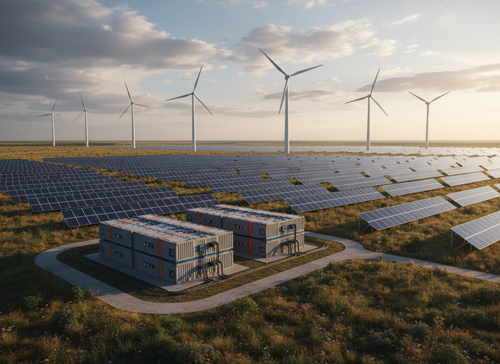
Unpredictable weather conditions cause fluctuations in green electricity production, which reduces the security of supply and economic efficiency of the plants. But this is not inevitable. The solution: hybridisation, combining different power sources at a single location. “This is the application of the classic investment rule – risk diversification – to energy generation“, comments Patrick Lemcke-Braselmann, Co-CEO of the aream Group, which is considering hybridisation for its plants.
The weather is only reliable to a limited extent. Sometimes the sun is blazing, then the sky is overcast. Sometimes the wind sweeps across the land, then there is calm for weeks on end. This is not only felt by holidaymakers, but also by green electricity producers: yields fluctuate with the weather, which affects the economic viability and efficiency of production and also necessitates fossil fuel back-up systems.
This is why the next stage in the energy transition is now strategically necessary. “We want to use hybridisation to combine two or more energy generation technologies at a single location“, says Lemcke-Braselmann. Photovoltaics + wind power or photovoltaics + battery storage are suitable combinations, for example. This increases security of supply and smooths feed-in profiles.
“Of course, reserve power plants are still needed, but to a much lesser extent“, says Lemcke-Braselmann. This is because hybridisation can compensate for production losses from individual energy sources, for example when the wind is not blowing but the sun is shining. Peak loads or sudden drops in production are absorbed. The climate also benefits because fossil fuel back-up systems can be replaced by a combination of storage facilities and green electricity systems.
“Hybrid systems are the key to a stable and efficient energy system“, says Lemcke-Braselmann. “The intelligent combination of generation and storage can balance out weather-related fluctuations and make more efficient use of grid connections.“ Shared infrastructure, lower operating costs and faster approval procedures further increase the economic viability of such projects. “This is also worthwhile for municipalities and property owners, who can achieve greater local added value“, says Lemcke-Braselmann.

PRESSEKONTAKT:
Leandra Kiebach
T: +49 (0)211 30 20 60 4-2
E: lk@aream.de