


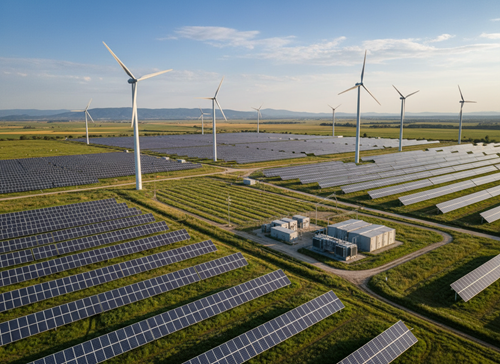
The current debate surrounding new guidelines from the Federal Ministry for Economic Affairs and Energy for the expansion of renewable energies shows how conditions for project developers and investors could change. Regulatory measures as part of a grid package and additional requirements are intended to slow down expansion and adapt it to the sluggish expansion of the grid. At the same time, new opportunities are emerging. “The hybridisation of existing energy projects is a key approach to implementing economically viable solutions under these conditions“, says Patrick Lemcke-Braselmann, Co-CEO of aream Group SE.
As renewable energies are expanded, grid connections and supraregional transmission capacities remain scarce. New regulatory requirements are set to increase the cost of project development and implementation. At the same time, there is a growing need for flexibility in the electricity system. Hybrid projects offer concrete answers here: for example, the shared use of grid connections by photovoltaic systems and battery storage facilities enables better utilisation of existing infrastructure. Projects can be implemented more quickly without requiring additional grid capacity, and battery storage increases the flexibility of feed-in. This allows electricity to be marketed specifically during hours when prices are higher, negative price phases can be avoided, and revenues become more stable.
“Today, electricity marketing expertise is one of the keys to implementing projects profitably“, says Lemcke-Braselmann. “Those who think about generation and marketing together can implement projects even under stricter requirements.“ Co-located battery storage in combination with photovoltaics creates additional sources of revenue. They enable the timing of feed-in to be shifted and volatile market phases to be exploited. This increases the revenue potential compared to pure solar projects. At the same time, the importance of spot and flexibility markets is growing. New contract structures such as hybrid PPAs and tolling models improve the predictability of revenues.
Older solar parks in particular are seeing new prospects after the feed-in tariff period: “Many existing plants are under pressure from falling market values and frequent negative price hours“, says Lemcke-Braselmann. “Adding battery storage can strengthen these plants economically and significantly extend their value creation phase.“ This creates additional marketing options and, in addition, often allows more capacity to be installed on existing sites than at the time of the original commissioning.
Hybridisation is also becoming increasingly important for grid operators. Long queues for grid connections remain a key obstacle, while at the same time the demands on grid stability are increasing. Hybrid projects can address both challenges. “They increase the utilisation of existing connections and create flexibility in the system“, says Lemcke-Braselmann. “Regulatory adjustments to recognise storage facilities as grid infrastructure have therefore become more important.“
“However, co-located storage facilities are not automatically approved“, says Lemcke-Braselmann. “Clear and reliable framework conditions remain crucial for investments.“ Market design changes further strengthen the role of storage facilities, as do new products in the intraday and spot markets. Increasing price volatility increases the chances of flexible assets being used. Successful concepts combine technical integration with marketing expertise.
Against this backdrop, expansion in the area of hybrid projects is a competitive advantage. The aim is to implement photovoltaic and storage projects together and make efficient use of existing grid connections.
“We are interested in partnerships with developers and in acquiring further development portfolios“, says Lemcke-Braselmann. “Hybridisation, shared grid connections and marketing expertise are the answer to the current requirements.“

PRESSEKONTAKT:
Leandra Kiebach
T: +49 (0)211 30 20 60 4-2
E: lk@aream.de