


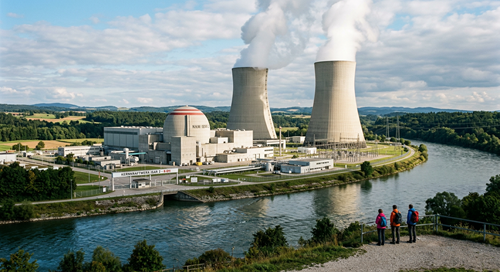
Many nuclear power stations across Europe have been shut down due to a lack of cooling water. Hungary is temporarily losing half of its electricity generation as a result of the outage at the Paks nuclear power station. This is not an operational accident. It is the consequence of an energy system that relies on a small number of large power stations, thereby creating a concentration of risk. The dry summer has laid this risk bare. And yet such hot months are set to become more common rather than less so. – A commentary by Markus W. Voigt, Executive Chairman of the aream Group.
Large power stations appear efficient at first glance. Few plants, clear logistics chains, output that is easy to plan. Yet this concentration becomes a weakness if even a single factor fails. A river with too little water is enough to affect millions of people and businesses. Production chains grind to a halt. During a heatwave, power shortages can also have very tangible consequences: from air-conditioning systems failing – posing risks to the sick and the elderly – to problems with cold chains for food and medicines. Furthermore, a single site also presents a major vulnerability in terms of security policy.
The alternative is decentralisation, moving away from large clusters. Renewable energies spread generation across thousands of sites. If one plant fails, the others carry on running. This dispersion makes the system more robust. However, renewables will only realise their full potential if Europe adopts a more European approach to electricity as well.
A truly highly efficient European electricity market would create precisely the balance that is currently lacking. If the sun is shining in Spain and the wind is blowing in northern Germany, whilst rivers in Central Europe are too warm to cool power stations, electricity must be able to flow to where it is needed. To achieve this, Europe needs more cross-border interconnectors and higher-capacity transmission lines. This is not an ideological concept, but a safeguard against supply bottlenecks. It stabilises prices and makes rationing – as seen in Hungary – significantly less likely.
Storage is just as important. Batteries and pumped-storage facilities shift electricity to where it is needed at any given time. Every kilowatt-hour stored locally and in a way that benefits the grid relieves pressure on the grids and increases security of supply. Storage does not replace grid expansion; it makes it more efficient. The two go hand in hand.
It is often argued that nuclear power stations – just like fossil-fuelled power stations – provide a reliable supply, whereas wind and solar power are weather-dependent. Yet it is precisely for this reason that Europe needs more interconnection, not less. A continent with thousands of generation plants, high-capacity grids and sufficient storage capacity can balance out fluctuations that individual regions could never cope with on their own. With every additional grid node, every storage facility and every new interconnection, dependence on individual power stations, individual rivers and individual weather conditions decreases.
Hungary is currently demonstrating where concentrated risks lead, and is only managing the shutdown thanks to cross-border interconnectors with its European neighbours – precisely the infrastructure that is largely lacking in many places. The lesson to be learnt is therefore not to build the next centralised system. The lesson is to diversify generation, grids and storage more broadly and to view Europe as a single electricity market. Anyone investing in this infrastructure today is investing in stability, security and strategic independence. This is not ideology. It is sound risk management.

PRESSEKONTAKT:
Leandra Kiebach
T: +49 (0)211 30 20 60 4-2
E: lk@aream.de