


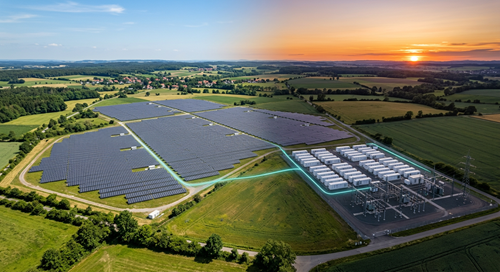
The problem is well known: solar power systems feed their electricity into the grid during periods of high sunshine. The more systems that do so, the lower the price they achieve. In this way, they cannibalise their own revenues. Storage systems break this vicious circle: “Anyone who optimally coordinates storage, photovoltaics and grid connection can turn the structural problem of cannibalisation into a manageable driver of value”, says Patrick Lemcke-Braselmann, CEO of the aream Group.
Until now, there has been one clear indicator of cannibalisation in the solar power sector: the solar capture rate. It measures the average price actually achieved by solar power, compared with the average electricity market price across all hours (baseload price). A capture rate of 60 per cent therefore means that solar power achieves, on average, only 60 per cent of the general electricity market price. If a particularly large amount of solar power is fed into the grid at midday or during sunny months, the exchange price falls during precisely these hours, and with it the value of the solar power. With the rapid expansion of photovoltaics, the solar capture rate has fallen in recent years: from around 58 per cent in 2024 to 50.5 per cent in 2025. It is particularly low in spring and summer, when PV systems generate the most electricity. According to the London-based analysis firm Modo Energy, it stood at 43.6 per cent in the second quarter of 2026, although this was a good ten percentage points higher than a year earlier.
But times are now changing. “Until now, the solar capture rate has been a uniform figure across the country”, says Lemcke-Braselmann. Every PV park in Germany had roughly the same generation profile and thus suffered a similar loss in value. With hybridisation through large-scale battery storage, this single curve no longer applies. This is because, if a project combines a PV system with battery storage, its revenue profile increasingly depends on its own storage capacity, control system and grid connection limits – not just on the general market situation.
This makes the sales profile considerably more flexible: a solar farm usually generates most of its electricity at midday, when prices are often low or negative. However, the electricity is not sold immediately at the low price, but is stored in the battery as long as capacity allows. At times of higher prices, the electricity is then fed into the grid, enabling the project to achieve a higher average price. This means that the average price achieved can exceed the baseload price.
This has implications for the solar capture rate: “A general market index becomes a key figure that each project reports individually”, explains Lemcke-Braselmann. The value ultimately achieved depends on the ratio between storage capacity and PV output, as well as the duration of storage. Two PV parks in the same region and with the same irradiation profile can therefore achieve very different capture rates.
However, it is not just the size of the PV system or battery that determines yield and capture rate. The grid connection – that is, the maximum power that the site is permitted to feed into the public grid at any one time – is often the decisive factor. “This means that the grid connection is now the most valuable asset in the park”, says Lemcke-Braselmann. Grid connections are in short supply, and waiting times often run to several years. Anyone who installs more PV capacity than the connection can accommodate and stores the surplus temporarily will generate significantly more revenue from every megawatt of connected capacity. However, the more storage systems are connected to the grid, the smaller the price differences between midday and evening will eventually become. “Those who adopt hybrid systems early and secure a connection will be one step ahead”, says Lemcke-Braselmann.
How the storage system is utilised is also crucial. It can enable pure time-shifting on the day-ahead market, trade during the course of the day, or provide balancing energy. Its marketing strategy determines when it charges, when it discharges, whether it sells energy at all or instead stabilises the grid. If the grid operator allows it, the battery can also draw ‘grey electricity’ from the public grid, not just the surplus from the installed PV system. This expands the options for profitable charging and discharging.
“Generic market price curves are therefore no longer sufficient to assess the quality of a project”, says Lemcke-Braselmann. Investors, banks and valuers can no longer rely on a generic German forecast of the solar capture rate. What is needed instead is modelling for each individual project at quarter-hourly intervals, taking into account the actual grid connection, the real storage capacity and the project’s own marketing strategy. “The capture rate is no longer a matter of market fate, but a management achievement. Anyone selling a pure PV farm today must expect significant price discounts compared with hybridised assets”, says Lemcke-Braselmann.

PRESSEKONTAKT:
Leandra Kiebach
T: +49 (0)211 30 20 60 4-2
E: lk@aream.de