


Despite the expansion of solar and wind power, gas-fired power stations continue to dictate the market price for many hours of the year. “Renewables have already brought down the average price of electricity significantly,” says Patrick Lemcke-Braselmann, CEO of the aream Group. “At the same time, however, the gap between very expensive and very cheap electricity prices is widening significantly.” But there is a solution.
The reason for the price-setting power of expensive gas-fired power stations lies in the so-called ‘merit order’, according to which – logically – the price is always set by the most expensive power station still required to ensure the supply of electricity for everyone. Consequently, a single gas-fired power station determines the price for all generators.
This reveals an almost paradoxical disconnect: on the one hand, the volume of electricity generated from fossil fuels is falling. On the other hand, the number of hours during which gas sets the price is rising. “In 2026, this share stood at 39 per cent, compared with 36.5 per cent the previous year,” says Lemcke-Braselmann. The reason lies in the timing of generation. Additional solar capacity primarily supplies electricity during the hours when renewable energies are already setting the price. “The evening hours are hardly affected by this. When the sun goes down, solar generation ceases regardless of the installed capacity.”
Nevertheless, it is evident that renewables are lowering the overall price level. In March 2026, the price of gas rose by 48 per cent compared with the previous month as a result of the war in Iran; nevertheless, the price of electricity fell by 0.7 per cent over the same period, as solar generation increases sharply in spring due to seasonal factors. This was made possible by an increasing decoupling of gas and electricity prices during hours with high levels of solar and wind feed-in. In March and April, gas-fired power stations set the price in only 24 to 27 per cent of hours. The rising annual figure therefore arises primarily during winter and evening hours, when there is a lack of sunshine and often wind as well. According to calculations by the Fraunhofer ISE, the electricity exchange price in April would have been 76 per cent higher without the expansion of renewables.
Renewables therefore influence the price level, but not yet the frequency with which prices are set. “The result is a market structure with a growing spread,” says Lemcke-Braselmann. So far in 2026, the average price stands at 103 euros per megawatt-hour, whilst negative prices were recorded in 7.5 per cent of all hours. Very cheap and very expensive hours are therefore increasing at the same time.
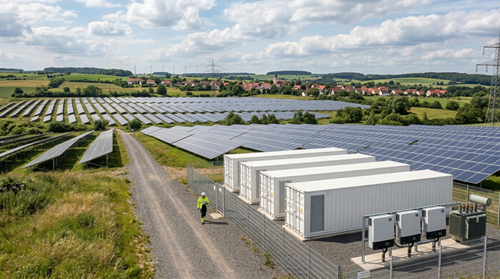
To actually reduce the number of hours in which expensive power stations set the price, storage is needed above all else. “Only when battery storage shifts solar power into the evening hours will a battery increasingly take the place of a gas-fired power station,” says Lemcke-Braselmann. “This means that gas loses its power to set prices.”
This development also presents an economic opportunity. The continued expansion of solar and wind power is increasing the scope for returns from battery storage faster than it is reducing the role of gas in the market. This creates a growing business opportunity for operators of storage projects, particularly when combined with existing solar or wind farms. Such co-location projects share the grid connection and charge directly using low-cost solar power. This makes them more resilient to falling price spreads than standalone storage facilities without their own generation capacity, particularly as many more batteries are connected to the grid in the coming years. “We are therefore specifically focusing on the combination of photovoltaics and battery storage in Germany and Spain,” says Lemcke-Braselmann. The transformation of the electricity market is thus taking place in two distinct phases. First, the volume of fossil fuel generation is falling; in future, the pricing power of fossil fuel power stations will also decline. “Storage systems are already worthwhile today because they benefit from the growing price differentials throughout the day. And their value continues to rise the more fossil fuel power stations lose their influence,” says Lemcke-Braselmann.

PRESSEKONTAKT:
Leandra Kiebach
T: +49 (0)211 30 20 60 4-2
E: lk@aream.de