


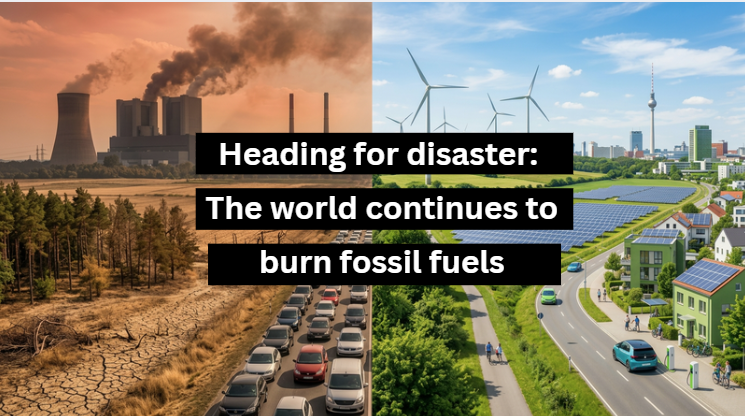
The Middle East is in flames – and so is the world. According to the latest data, the atmosphere is warming at an ever-increasing rate, sea levels are rising and glaciers are melting. “For Germany alone, the costs of climate damage are likely to amount to hundreds of billions of euros in the coming decades“, comments Patrick Lemcke-Braselmann, Co-CEO of the aream Group. “Nevertheless, the fact that climate protection is an economic necessity is being forgotten or denied.“
Ten years after the Paris Climate Agreement came into force, current data shows that global warming has accelerated significantly since the mid-2010s. The Reuters news agency provides a horror list of the latest research:
• The World Meteorological Organisation's Global Atmosphere Watch network shows that concentrations of carbon dioxide, methane and nitrous oxide have risen to record levels. According to the latest Global Carbon Budget Report, global carbon dioxide emissions from fossil fuels are expected to reach a record 38.1 billion tonnes in 2025 – a consequence of higher consumption of coal, oil and gas. According to the 130 scientists, the CO₂ concentration in the atmosphere rose by 52 per cent above pre-industrial levels.
• NASA's Goddard Institute for Space Studies has calculated that last year's global temperature was 1.19 degrees Celsius above the 1951–1980 average, making 2025, along with 2023, one of the warmest years since records began.
• The 2025 Arctic Report from the US National Oceanic and Atmospheric Administration (NOAA) confirms that the period from October 2024 to September 2025 was the warmest since 1900 and that the region continues to warm more than twice as fast as the global average. The Intergovernmental Panel on Climate Change (IPCC) predicts a sea level rise of 0.20 to 0.29 metres by 2050 compared to 1995–2014.
“The world is still burning vast amounts of fossil fuels“, says Lemcke-Braselmann. At the same time, environmental regulations are being watered down and the expansion of renewable energies is being slowed down by bureaucracy and the deliberate creation of regulatory uncertainty. This is the wrong direction to take, and we are trying to counteract it with our investments."
However, the German solar plants of the aream Group had a difficult time last February, with the deep winter catching their performance cold: only 64 per cent of the target value was achieved. “Few hours of sunshine, snow and ice on the modules and a few minor technical failures led to this result“, explains Lemcke-Braselmann. Things went better in southern Europe: the aream plants in Spain achieved 81 per cent of their target values: “A solid performance with few hours of sunshine“, says Lemcke-Braselmann. Weak irradiation values, the failure of a transformer and several minor malfunctions in Italy meant that the target value was undershot by 20 per cent. The yields from aream's German wind turbines remained disappointing: with a target achievement of just under 76 per cent, performance was similar to that in January. The wind was simply too weak compared to the long-term average.

PRESSEKONTAKT:
Leandra Kiebach
T: +49 (0)211 30 20 60 4-2
E: lk@aream.de