


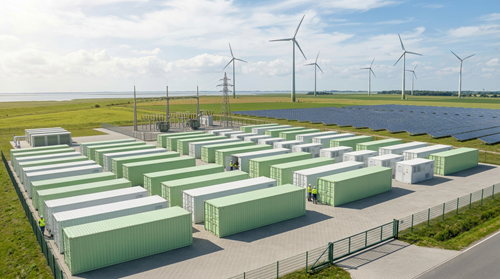
Despite some setbacks, there has also been tangible progress in the transition of the energy sector towards domestically available renewable energy sources. “The key driver is making the previously rigid rules governing grid connection more flexible”, says Patrick Lemcke-Braselmann, CEO of the aream Group. “By allowing more providers to share grid access, the expansion of renewable energy, particularly green electricity storage facilities, will be measurably accelerated.”
The mechanism in question is Flexible Connection Agreements (FCAs). “These flexible grid connection agreements ensure that photovoltaic systems and battery storage facilities, in particular, can be connected to the grid more quickly”, says Lemcke-Braselmann. “This alleviates existing bottlenecks in grid connection.” To this end, the FCAs control, amongst other things, changes in power output, in particular the so-called ramps. This refers to the speed at which feed-in or off-take power can be adjusted.
“Power grids are sensitive to abrupt changes in power, which is why a relatively large buffer must be built in,” says Lemcke-Braselmann. “The FCAs now stipulate that whilst the systems are permitted to connect to the grid, they must commit to a certain level of ‘good behaviour’.” This ‘good behaviour’ is defined by the ramps – that is, the values by which the installations are permitted to change their feed-in or withdrawal of electricity from the grid.
“A battery storage system with a capacity of ten MW and a ramp limit of ten per cent per minute may only increase or decrease its feed-in by one MW per minute”, said Lemcke-Braselmann. “This adjustment, which may seem relatively minor, takes a huge strain off the grids and ensures system stability, even if the return on investment is slightly reduced due to the restrictions.” And this can be achieved without the need to accelerate grid expansion further. “This approach is a good compromise, as it makes it easier for grid operators to approve connections and, among other things, to adjust and specify ramp rates”, says Lemcke-Braselmann.
This additional flexibility makes it possible to make better use of existing grid capacities. “Projects that were previously unfeasible due to rigid connection conditions can now be implemented”, says Lemcke-Braselmann. “This applies in particular to regions with already strained grid situations, where the need for (network-related) storage solutions is particularly high.”
The Federal Network Agency is expected to issue the first regulatory guidelines for this development by the end of May. This will lay the groundwork for implementing FCAs. “Distribution system operators are currently in the standardisation phase”, says Lemcke-Braselmann. “The first offers for flexible grid connections are being prepared and should be available soon.” For the market, this opens up new prospects. “Over the next three years, we can expect a significant acceleration in approvals and the expansion of green energy storage facilities”, says Lemcke-Braselmann. “This will give a rapid boost to some projects, and investment decisions will gain greater planning certainty.”
“The introduction of flexible grid connection models is a wonderfully pragmatic approach to reducing existing hurdles whilst ensuring the stability of the system”, says Lemcke-Braselmann. “Even though the further expansion of the grids must, of course, continue, it is clear that with mutual goodwill, much can be achieved quickly.”
PRESSEKONTAKT:
Leandra Kiebach
T: +49 (0)211 30 20 60 4-2
E: lk@aream.de