


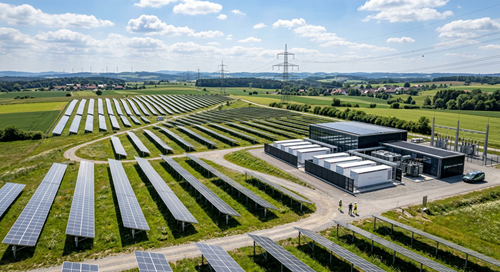
– It is only a minor regulatory change, but it has the potential to significantly transform the market for green electricity and battery storage in Germany. “To maintain the stability of the electricity grid, grid operators pay power stations and storage facilities to keep reserve capacity available at short notice. “Until now, anyone wishing to offer this reserve had to guarantee it for at least four hours at a time”, says Markus W. Voigt, Executive Chairman of the aream Group. “From autumn 2026, there will also be the option of guaranteeing it for just 15 minutes.” A minor technical change in the German balancing energy market is thus opening up a new business model for operators of solar parks with battery storage.
With the introduction of the optional 15-minute products in the secondary control power (aFRR) market, green energy storage systems now have significantly easier access to an additional revenue stream for the first time. Until now, providers of secondary control power had to guarantee their output for at least four consecutive hours. “For battery storage systems operated in conjunction with PV installations, this requirement was often a deal-breaker”, says Voigt. “This is because the electricity output of a solar installation varies considerably within a four-hour time window.” The associated forecasting risks and opportunity costs are correspondingly high. The market therefore remained largely the preserve of conventional power stations and stand-alone battery storage systems.
Now, this picture is changing fundamentally. In future, operators will be able to align their available capacity more precisely with actual electricity generation and storage capacity. A technical adjustment is thus giving way to a structural opening up of the market. “The introduction of the 15-minute products is far more than a minor change to the market design”, says Voigt. “For the first time, it creates a level playing field for renewable energies in the balancing energy market.” This creates an additional business model for green electricity storage: the combination of a solar park and battery storage is evolving from a pure producer into a provider of flexibility solutions for electricity.
The first developments are already visible. In early 2026, the Schkölen solar park in Thuringia became the first photovoltaic plant to be pre-qualified for secondary control power. Wind farms, too, are increasingly meeting the technical requirements for participation in the balancing energy market. With the new time-based products, this development is likely to gain momentum.
This is because, in addition to marketing the electricity generated and traditional arbitrage between low and high electricity prices, a further source of revenue will be added in future. The physical link between solar power and balancing energy is particularly attractive in this context. At midday, when solar production is high, there is often a need for negative balancing power, which a solar farm with a green electricity storage system can provide: on demand, the feed-in is reduced and the electricity is instead directed into the battery. “A payment is made for this, and the stored energy is sold in the evening hours, when prices are typically higher”, says Voigt.
This creates multiple revenue streams from the same infrastructure: the battery storage system not only shifts solar production over time but also contributes to system stability. For investors, this makes revenue planning more predictable. “Institutional investors are looking for business models with multiple independent revenue streams”, says Voigt. “The broader a project’s revenue profile, the more robust its economic viability becomes. This is precisely the trend we are now seeing with green electricity storage systems.”
However, the opening up of the market will also change the competitive landscape. More participants mean falling revenues in the balancing energy market in the long term. This process has already begun. The pre-qualified battery capacity for positive secondary control power has more than doubled within a year. At the same time, average capacity prices have already fallen significantly. Experience from France also shows that additional market participants lead to falling remuneration rates.
For operators of green electricity storage systems, however, this does not represent a disadvantage. Unlike stand-alone batteries, their business model has not, until now, been based on revenue from balancing energy – that is, the provision of flexibility to ensure grid stability. “They benefit from shared infrastructure with the photovoltaic system, lower maintenance costs and multiple marketing channels,” says Voigt. “Balancing energy is therefore an additional source of revenue and not the sole source of income.”
The reform thus marks a shift that extends beyond the balancing energy market. It lowers barriers to market entry and turns flexibility into a business model in its own right. Whilst the energy policy debate has recently been dominated by restrictions and uncertainty, the regulation now provides an impetus that makes the expansion of solar parks with battery storage systems more economically attractive and opens up new market opportunities for renewable energies.

PRESSEKONTAKT:
Leandra Kiebach
T: +49 (0)211 30 20 60 4-2
E: lk@aream.de