


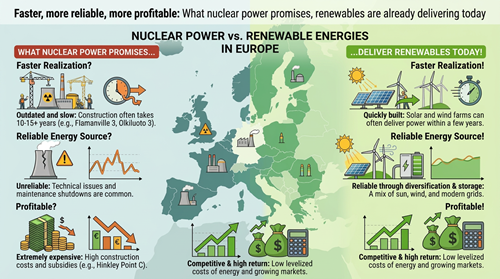
In the face of geopolitical crises, Europe needs secure and cost-effective energy solutions, and some regard nuclear power as a climate-friendly alternative. Yet examples from France and the UK prove the opposite. “Nuclear power is too expensive, too slow and not as reliable as is often assumed,” comments Patrick Lemcke-Braselmann, CEO of the aream Group. “The consistent expansion of renewable energies remains the only path that is not only sustainable but also delivers a return on investment much more quickly.”
Against a backdrop of geopolitical tensions and rising energy prices, the debate over nuclear power is reigniting in Europe. European Commission President Ursula von der Leyen described Europe’s move away from nuclear power as a “strategic mistake”. In Germany, too, despite the nuclear phase-out having been finalised, there is renewed debate over extending the operating life of existing plants and building new ones. Small modular reactors (SMRs) are fuelling political hopes. “But this is the wrong path to take,” explains Lemcke-Braselmann.
Nuclear energy is very expensive and can only survive with massive state subsidies – and even then, it comes too late. Both points can be seen in the British example of Hinkley Point C: Approved in 2016 and originally planned for 2025, the commissioning of Unit 1 has now been postponed to 2030 – with costs having doubled compared to the original plan. And as soon as the reactor comes online, a government-guaranteed purchase price, indexed to inflation over 35 years and currently standing at around 150 euros/MWh, will come into effect. For British electricity customers, this will become a persistent problem, as energy from solar and onshore wind farms is already available today – particularly when combined with battery storage – at significantly lower prices, and will become even cheaper by 2030. “The oft-repeated myth of cheap nuclear power does not stand up to a realistic cost analysis,” says Lemcke-Braselmann. Solar, wind and storage projects follow a different logic: they are implemented in a modular and parallel manner; it usually takes three to seven years from approval to commissioning – and the required generation equivalent can thus be connected to the grid within the current investment horizon.
The assumption that nuclear reactors are more productive can also be easily refuted: A 1-GW reactor produces around 8,000 GWh per year. The same output can be achieved in Germany with, for example, 3 GWp of solar and 2.5 GW of onshore wind – a total that even leaves a reserve to cover grid and storage losses. Battery storage systems smooth out the feed-in profile and thus largely take over the reactor’s base load function.
Furthermore, it is becoming increasingly clear that nuclear power is by no means safe or independent of environmental conditions. In France, for instance, ongoing heatwaves are currently forcing several nuclear power stations to reduce their output or shut down temporarily. The reason lies in the cooling of the reactors: rising river temperatures and falling water levels are jeopardising compliance with environmental regulations. “This problem occurs regularly,” explains Lemcke-Braselmann. In 2025, too, output had to be reduced at sites such as Blayais, Bugey and Golfech – and this, of all times, at a period when air conditioning systems were driving electricity demand to record levels.
Solar energy, by contrast, delivers peak yields precisely during the height of summer or can be shifted to these periods via battery energy storage systems (BESS). “Renewables can increase security of supply whilst simultaneously strengthening energy independence,” explains Lemcke-Braselmann. Spain, for example, has been able to significantly reduce its dependence on French electricity imports through the massive expansion of solar energy. Since 2024, there has been no structural dependence – imports and exports are in balance.
“Europe faces the challenge of making its energy supply affordable and climate-friendly,” says Lemcke-Braselmann. “New nuclear power stations do not help in this regard; they do not meet these requirements. And when it comes to resilience and vulnerability, decentralised renewables are also superior to nuclear power.”
PRESSEKONTAKT:
Leandra Kiebach
T: +49 (0)211 30 20 60 4-2
E: lk@aream.de