

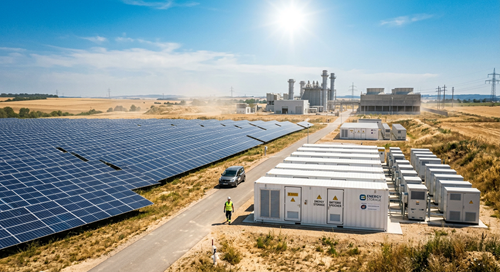
A heatwave, rising demand for cooling, peak load: according to conventional market logic, the price of electricity in Germany should have risen sharply in the current situation. Gas-fired power stations are on standby in such situations – at prices of 600 to 800 euros per megawatt-hour. “But the market told a different story”, says Patrick Lemcke-Braselmann, CEO of the aream Group. “During the day, the day-ahead price remained well below 100 euros.” The reason: solar power took on a large share of the load before the gas-fired power stations were even needed.
Accounting for around 30 per cent of the German electricity mix, photovoltaics set a new record in June 2026 – and kept prices stable. “Anyone who bought electricity in the morning and throughout the day paid solar prices, not gas prices”, said Lemcke-Braselmann. “According to the textbook, there should have been an upward price spiral – but that didn’t happen.” It was only in the evening, when the sun went down and the demand for cooling remained high nonetheless, that prices shot up to between 600 and 800 euros. “But this wasn’t due to high fuel costs, but because gas-fired power stations had to spread their total start-stop fixed costs of around 400 euros per megawatt over a very short period,” says Lemcke-Braselmann. “The more solar power is supplied during the day, the shorter the gas turbine runs in the evening – and the more expensive the gas-generated electricity becomes.”
That is the key point of the heatwave: “Two pricing regimes now exist side by side,” says Lemcke-Braselmann. “During the day, PV supplies power for well under 100 euros; in the evening, gas steps in and drives the price up to more than 600 euros.” This difference is structural – and it grows with every additional solar panel.
It is precisely this spread that provides the economic leverage for battery storage. “A storage system that captures cheap solar power during the day and discharges it into the expensive window in the evening capitalises on exactly this price difference”, says Lemcke-Braselmann. “According to preliminary calculations, the capture rate for solar installations was already around 60 per cent in June. With storage, this could be improved further, because the electricity no longer flows into the grid at low prices but is specifically shifted to cover the evening peak.” At the same time, storage would further displace expensive gas-fired power stations: less gas fed into the grid means lower evening prices for consumers.
The maths is simple: without storage, a megawatt-hour of peak evening electricity costs between 600 and 800 euros. With sufficient storage capacity, a large proportion of this peak could be cut. Europe must increase its storage capacity tenfold by 2030, from the current 77 gigawatt-hours to around 750 gigawatt-hours – and Germany is at the forefront of this effort. “The heatwave was a real-world test”, says Lemcke-Braselmann. “The result: solar power keeps prices down – as long as the sun is shining. What happens afterwards depends on storage.”
PRESSEKONTAKT:
Leandra Kiebach
T: +49 (0)211 30 20 60 4-2
E: lk@aream.de