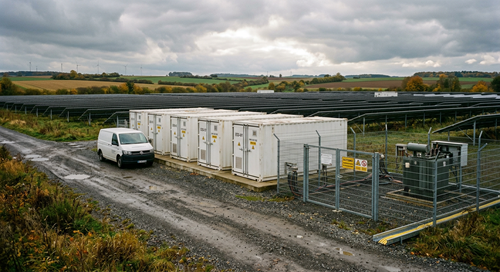
As a rule of thumb, the higher the return, the better the investment. But appearances can sometimes be deceiving: “Anyone building a battery storage facility next to a solar park should not automatically opt for the option with the highest return,” advises Patrick Lemcke-Braselmann, CEO of the aream Group. This is because the base-case scenario does not always materialise, and market conditions change – sometimes for the worse. “It’s not just a question of how high you can rise, but also how low you can fall.”
Anyone analysing the financials of an investment project is quick to opt for the option offering the highest return. However, it is not just the peak value in the base case that counts, but also how robust a storage configuration is. “By ‘robust’, we mean that a project not only performs well under a single assumption, but also holds up in many possible future scenarios,” says Lemcke-Braselmann. To this end, factors such as grid connection, storage capacity and storage duration are tested against various electricity price curves.
A design is considered robust if, even in the worst-case scenario, it still exceeds the minimum rate of return and never falls far behind the best alternative in each case. The design offering the maximum return is quite different: it is optimised for the most favourable scenario and achieves the highest return on investment there. “However, if the market deviates from the assumptions, this can prove to be very detrimental,” explains Lemcke-Braselmann.
“We always run through a great many scenarios for every project,” says Lemcke-Braselmann. The selection process takes place in several stages: first, configurations that are not permitted from a grid or contractual perspective are filtered out. Next, variants that perform worse than any other in every scenario are eliminated. The robustness filter retains only those variants that exceed the minimum rate of return in all scenarios. From the remaining options, aream uses the Pareto front to determine the best compromise between return and dispersion. The result is a specific specification comprising output, capacity, grid connection and C-rate, which indicates how quickly a battery storage system can be charged or discharged in relation to its size.
The result of the analysis: in the base case, the design optimised for maximum return achieves the highest IRR. Those who opt for the robust variant instead do not quite maximise this potential and, in return, sacrifice a few tenths of a percentage point. “That is the price of robustness,” says Lemcke-Braselmann. Its benefits become apparent as soon as market conditions deteriorate. In the unfavourable scenario, the return-maximising variant falls below the minimum rate of return, whilst the robust variant performs significantly better.
“Electricity prices, market rules and investment costs are uncertain,” summarises Lemcke-Braselmann. “A configuration that performs brilliantly under one assumption may fail under another.” It is therefore not a question of which configuration performs best in a single scenario, but rather which one “can withstand a bit of a knock”. Here, too, resilience counts.
Investors should therefore always assess the return in conjunction with its variation across different price curves and cost assumptions. What matters is not just the peak value, but whether a design remains above the minimum rate of return even in a worst-case scenario. Ultimately, says Lemcke-Braselmann, it is important to bear in mind an asymmetry: “The additional return from the design offering the highest yield is relatively small in the base case. The downside risk, however, is not.”

PRESSEKONTAKT:
Leandra Kiebach
T: +49 (0)211 30 20 60 4-2
E: lk@aream.de