

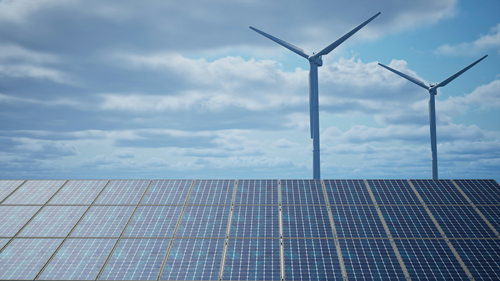
Three European markets – three strengths in the expansion of renewable energy: Italy offers predictability through state guarantees, Spain stands out for its structural decoupling from gas, and Germany impresses with its market maturity and scale. “The key to success remains flexibility: storage, grid contribution and appropriate market design,” comments Patrick Lemcke-Braselmann, CEO of the aream Group.
The expansion of renewable energy is underway across Europe, with each country following its own path. For investors, this means varied opportunities and risks arising from regulation, price trends and infrastructure. This is illustrated by the examples of Italy, Spain and Germany.
Italy: Predictability meets gas risk
The installed photovoltaic capacity stands at around 43.5 GW – putting Italy in second place in Europe – with a nominal increase of around 6.44 GW expected in 2025. Solar generation is growing by around 25 per cent. Italy is achieving this, amongst other things, through investment security via the CfD-based FER-X system, which is holding its first 7.7 GW solar auction at 56.82 euros/MWh with a 20-year government guarantee. “This predictability is attractive to long-term investors who prioritise stability,” explains Lemcke-Braselmann. The MACSE programme, which focuses on procuring electricity storage capacity, further strengthens storage and co-location potential. The main problem facing the country is that Italy remains dependent on gas. “In around 70 per cent of hours, gas determines electricity prices, leading to higher costs and greater volatility,” says Lemcke-Braselmann. Furthermore, political uncertainty and a fragmented bu-reaucracy increase investment risks. For investors, this means that, whilst Italy generally offers clear pre-dictability, this is coupled with bureaucratic challenges – particularly in relation to approval processes – and the country is heavily dependent on gas. The ability to react quickly to regulatory changes and to integrate storage solutions effectively remains crucial.
Spain: Decoupling, but market cannibalism
In contrast, Spain shows clear gas decoupling: the gas price sets the electricity price in only around ten per cent of hours, and the forecast for 2026 stands at approximately 66 euros/MWh – that is roughly half the Italian electricity price. This structure means more price-stable electricity. Another plus point: on good days, renewables cover 85 to 90 per cent of demand, and the storage boom is also continuing – an indicator of attractive growth potential. The key problem, however, is cannibalisation effects: by 2025, solar power was generating, on average, only 54 per cent of the general electricity market price. At midday, prices fall into negative territory, curtailments increase, and long-term power purchase agreements (PPAs) come under pressure. “Furthermore, the approval process for expansions often takes far too long – well over twelve months – even for green energy storage facilities,” criticises Lemcke-Braselmann. “Despite these challenges, Spain offers interesting opportunities for investment in storage capacity and hybrid potential,” says Lemcke-Braselmann. “Provided, that is, that investors can effectively manage regulatory delays.”
Germany: ripe for major investment, but with political risks
Europe’s largest solar market, at around 117 GW, remains the most mature from a regulatory perspective, with a target of 215 GW by 2030. The EEG, which will remain in its current form until the end of 2026, pro-vides predictability for infrastructure planning, whilst battery storage offers particularly attractive potential returns. The regulatory framework for green electricity storage, which can be implemented relatively quick-ly, is favourable, whilst grey electricity storage remains significantly more challenging. The Solar Peak Act prevents feed-in tariffs for installations connected to the grid from February 2025 onwards when exchange prices are negative. Reforms have been announced for 2027, but “their economic impact cannot yet be assessed in detail”, says Lemcke-Braselmann. The key challenge remains the political planning uncertainty caused by the “Grid Package”. Added to this are bottlenecks: distribution networks reach their capacity limits at midday. This presents economic opportunities and growth potential, but also entails a risk.
Conclusion: From a consumer perspective, Spain comes out on top in terms of price – but needs flexibility on the generation side to achieve attractive returns. From an investor’s perspective, Italy offers the greatest predictability – but remains dependent on gas, with high prices for consumers. Germany leads in terms of market maturity – but is currently risking investor confidence due to unclear prospects for the period from 2027 onwards. “What these markets have in common is that they require flexibility,” says Lemcke-Braselmann. “Investment success therefore depends on storage, grid-supporting control mechanisms and an adapted market design.” The development of storage and grid services is key to realising value creation beyond mere electricity generation. “Portfolio diversification across these three markets reduces country-specific risks and opens up potential for scaling up in a changing European energy market,” explains Lemcke-Braselmann.

PRESSEKONTAKT:
Leandra Kiebach
T: +49 (0)211 30 20 60 4-2
E: lk@aream.de