


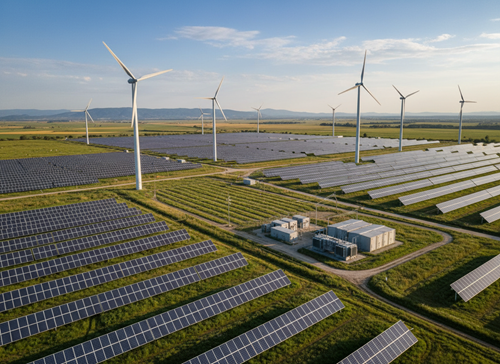
Crises and wars can only continue to affect energy prices, the economy and the labour market for as long as fossil fuels remain the dominant factor in price setting. But that is changing: “Wind and solar power plants, with very low variable operating costs, are increasingly displacing expensive gas-fired power stations from their price-setting position – thereby making electricity prices more stable and predictable”, says Patrick Lemcke-Braselmann, CEO of the aream Group. “This effect is already measurable today.”
The electricity exchange operates on the merit-order principle: power stations are deployed according to their marginal costs – the cheapest first, the most expensive last. “As wind and solar plants have virtually no variable operating costs, they are increasingly pushing expensive gas-fired power stations out of the price-setting position”, says Lemcke-Braselmann. “As a result, the share of gas in electricity generation is falling, and with it the exchange price of electricity.” This merit order effect is already evident on every sunny or windy day.
The Ukraine crisis, just like the current war in Iran, clearly demonstrates how vulnerable Germany is due to its dependence on fossil fuel imports. “When Russian gas failed to arrive, electricity prices skyrocketed – not because of a lack of generation capacity, but because of the structural link between the electricity price and the gas price”, says Lemcke-Braselmann. This will become less of an issue in future, because the more renewable energies take over price formation, the less a gas price shock can affect the electricity bill. “This decoupling is one of the most important contributions to stability made by the energy transition”, says Lemcke-Braselmann.
Added to this is geostrategic independence: “The wind blows in the North Sea just as it does on land; the sun shines on ground-mounted photovoltaic systems just as it does on rooftops”, says Lemcke-Braselmann. “Neither Doha, Moscow nor Riyadh will be sending us bills for this energy.” This is because renewable energies are domestic resources and thus a major boon for energy sovereignty. “The elimination of gas and coal imports not only reduces vulnerability to price shocks but also removes the basis for political blackmail”, says Lemcke-Braselmann.
Another, often underestimated advantage: “Photovoltaic systems in fields and on rooftops, wind farms spread across the entire country, and local battery storage – this decentralised system offers a resilience that centralised large-scale power stations cannot match”, says Lemcke-Braselmann. “There is no single target that a malicious actor could take out.” A decentralised grid is far more difficult to target through sabotage or infrastructure attacks than a few concentrated generation sites.
Storage systems are an increasingly important component in this regard. Battery storage, pumped-storage power stations and, in future, hydrogen can buffer out fluctuations in generation, thereby stabilising prices and grid frequency. “Storage systems provide system services such as frequency control and instantaneous reserve – functions that used to be performed exclusively by conventional power stations”, says Lemcke-Braselmann. “And they are now more than competitive.” The technology is available and is rapidly becoming cheaper. This means that dependence on gas imports is being steadily reduced.
The transformation of the electricity system towards renewables is, in this respect, anything but a gamble on uncertain future technologies. It is a stabilisation process already underway – economically, geopolitically and structurally. “Those who invest in wind, solar and storage today are not only building up CO₂-free capacity”, says Lemcke-Braselmann, “but are also making domestic electricity from renewables a stabilising anchor through price security, independence and resilience.”

PRESSEKONTAKT:
Leandra Kiebach
T: +49 (0)211 30 20 60 4-2
E: lk@aream.de