


The geopolitical situation shows us with brutal clarity how fragile the global energy system still is. A war against Iran would not only destabilise the region, but also strike at the heart of the global economy. Rising oil prices would also push up gas prices, supply routes through the Strait of Hormuz would come under pressure, insurance premiums would skyrocket, and freight routes would become unsafe. In a highly networked industry, this means nothing less than an acute risk to growth, investment and prosperity. Anyone who still clings to the illusion that fossil fuel dependencies can be moderated politically or contained diplomatically is ignoring the structural vulnerability of the existing energy supply system. – A commentary by Markus W. Voigt, CEO of aream Group SE.
A proposed solution of reviving nuclear energy seems remarkably unrealistic in view of the actual dependencies. France, traditionally pro-nuclear, imports significant quantities of natural uranium or re-enriched uranium from Russia, Kazakhstan and Uzbekistan. This means that supply chains are dependent on the wishes and will of these governments. There can be no question of strategic self-sufficiency. Those who promote nuclear energy as a guarantee of national sovereignty may be deliberately overlooking the upstream dependencies on fuel, enrichment and the geopolitical stability of the supplier countries.
In addition, new nuclear power plants are capital-intensive, complex in terms of licensing and associated with extremely long implementation periods. At a time when energy prices are rising sharply and industrial competitiveness is under immediate pressure, projects with a planning horizon of 15 to 20 years are of no help. They tie up capital that is needed for the accelerated expansion of actually available and scalable technologies. The idea that short-term energy policy crises can be solved with long-term nuclear projects is not tenable in terms of industrial economics.
The same applies, incidentally, to gas-fired power stations that are to be used as a strategic reserve, but for which construction has not even been planned yet. And Germany has had to learn the hard way in recent years what dependencies arise from the supply of natural gas or LNG, which are permanently necessary energy sources.
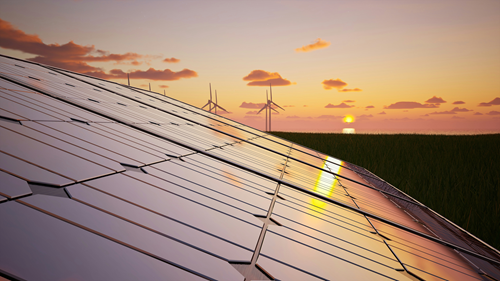
Genuine energy policy independence can therefore only be achieved where primary energy sources are available domestically. In Germany, the contribution of hydropower and biomass is structurally limited. Both technologies are mature, but their expansion potential is modest. The cornerstones of a sovereign energy supply are wind and solar energy. They are available nationwide, technologically mature, have fallen massively in price in recent years and can be installed on a large scale. Above all, however, they do not require geopolitically sensitive fuel imports.
Together with storage solutions that are now technically mature and increasingly attractive from an economic perspective, they are more or less immediately available to create energy policy independence. This is particularly true as they also have the advantage of being small-scale and networked compared to large, centralised plants, meaning that the failure of individual plants can be quickly compensated for by others.
Electricity from wind and solar power is a strategic necessity. Every additional kilowatt hour installed from renewable sources reduces import dependencies, stabilises price structures in the long term and strengthens industrial value creation in our own country. The value chains – from planning and construction to operation – are regionally anchored. Investments flow into infrastructure, grids, storage and flexibility options instead of raw material imports. And yes, some of the components still come from foreign sources, mainly China. However, this share is being reduced, and manufacturing facilities for these components can be set up quickly worldwide – and expanded in Germany. In terms of the resilience of the energy supply, however, the fact that no future dependencies are created after a one-time investment is even more significant.
Against this backdrop, it is incomprehensible why the expansion of renewable energies is still being slowed down by lengthy approval procedures, regulatory inconsistencies and political hesitancy. Anyone who, in a phase of escalating geopolitical risks, does not set the course for wind and solar energy with maximum determination is acting negligently in terms of energy economics. Security of supply, competitiveness and climate protection are not contradictions here, but rather overlapping interests.
The current crisis is not an argument for nostalgic technologies, but a wake-up call for structural transformation. Energy sovereignty does not come about through wishful thinking, but through consistent investment in domestic resources. Independence is not a buzzword, but the result of clear priorities. Those who are serious about it are focusing on wind and solar energy – without detours, without ideological smokescreens and without further delay.

PRESSEKONTAKT:
Leandra Kiebach
T: +49 (0)211 30 20 60 4-2
E: lk@aream.de